Media

Filter the library

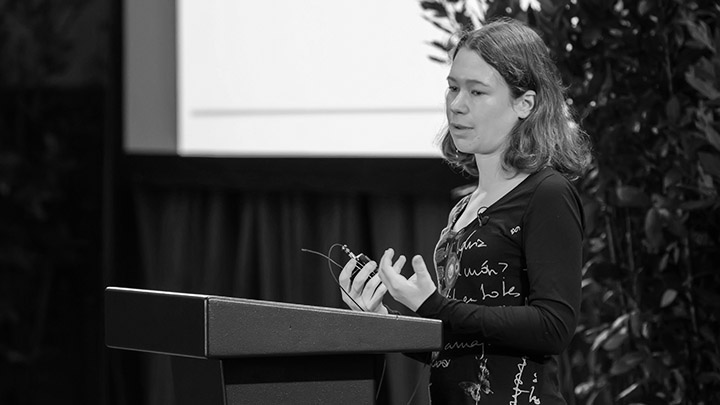
profile Gregor Weihs

Gregor Weihs is Professor of Photonics and Head of the Institute for Experimental Physics at the University of Innsbruck and an Associate of the University of Waterloo's Institute for Quantum Computing. While being on leave from his position in Vienna he spent two and a half years as Consulting Assistant Professor at Stanford University collaborating with the group of Yoshihisa Yamamoto (now at RIKEN) and Assistant Professor of Research at Tokyo University working on semiconductor quantum optics with Yasuhiko Arakawa's group. Gregor Weihs was DOC-fellow of the Austrian Academy of Sciences; he won the Appreciation Award of the Austrian Ministry of Science and Transport and the Loschmidt-Prize of the Chemical-Physical Society in Vienna. In 2007 he was awarded the Canada Research Chair in Quantum Photonics and in 2010 a Starting Grant by the European Research Council. In 2011 he was elected into the Austrian Academy of Sciences as a member of the Young Academy. His memberships include the Chemical-Physical, Austrian and American Physical Societies, the Canadian Association of Physicists, as well as the Optical Society of America. He is a fellow of the QIP program of the Canadian Institute for Advanced Research, and in addition currently holds grants from the European Research Council (ERC), and the Austrian Science Fund (FWF). In his research interests include fundamental physics both experimental and theoretical, quantum and semiconductor optics and quantum information. He currently focuses on novel sources of entangled photon pairs from nonlinear waveguides, via strong coupling in semiconductor microcavities, and from semiconductor quantum dots. He further does research is in quantum communication and the foundations of physics.

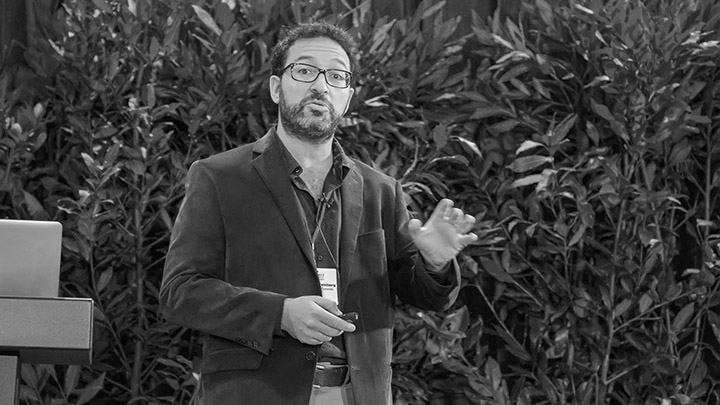
profile Aephraim Steinberg

Aephraim Steinberg is a Professor in the Department of Physics at the University of Toronto.  He is also a founding member of Toronto's Institute for Optical Sciences, a member and past director of the Centre for Quantum Information and Quantum Control (CQIQC), an affiliate member of the Perimeter Institute for Theoretical Physics and a principal investigator in Photonics Research Ontario, the Canadian Institute for Photonic Innovations, and QuantumWorks. Dr. Steinberg received his undergraduate degree from Yale University in 1988 and his Ph.D. from the University of California at Berkeley in 1994.  He then held post-doctoral fellowships at the Université de Paris VI and the U.S. National Institute of Standards and Technology before moving to Toronto in 1996.  He has been a guest professor at the University of Vienna; the Institut d'Optique Théorique et Appliquée in Orsay, France; and the University of Queensland in Australia. In 2006, he received the Canadian Association of Physicists Herzberg Medal and the Rutherford Medal in Physics from the Royal Society of Canada.  In 2007, he received a Steacie Fellowship from NSERC, and a McLean Fellowship (Connaught Foundation, University of Toronto).  He is a Fellow of the Institute of Physics (UK), the American Physical Society, and the Optical Society of America. He joined CIFAR's Quantum Information Science Program in 2003. Dr. Steinberg’s interests lie in fundamental quantum-mechanical phenomena and the control & characterization of the quantum states of systems ranging from laser-cooled atoms to individual photons.  His experimental program is two-pronged, using both nonclassical two-photon interference and laser-cooled atoms to study issues such as quantum information & computation, decoherence and the quantum-classical boundary, tunneling times, weak measurement & retrodiction in quantum mechanics, and the control and characterization of novel quantum states. (source: University of Toronto)  

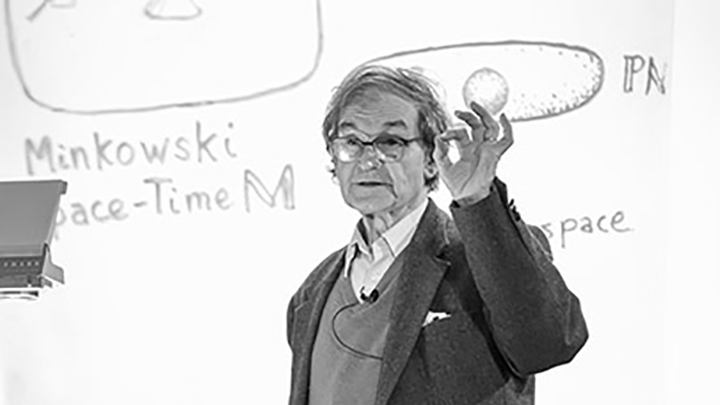
profile Edward Nelson

Edward Nelson (May 4, 1932 – September 10, 2014) was a professor in the Mathematics Department at Princeton University. He was known for his work on mathematical physics and mathematical logic. In mathematical logic, he was noted especially for his internal set theory, and his controversial views on ultrafinitism and the consistency of arithmetic. He also wrote on the relationship between religion and mathematics. Nelson was born in Decatur, Georgia. He received his Ph.D. in 1955 from the University of Chicago, where he worked with Irving Segal. He was a member of the Institute for Advanced Study from 1956 to 1959. He held a position at Princeton University starting in 1959, attaining the rank of professor there in 1964 and retiring in 2013. In 2012 he became a fellow of the American Mathematical Society. He died in Princeton, New Jersey on September 10, 2014. Nelson made contributions to the theory of infinite-dimensional group representations, the mathematical treatment of quantum field theory, the use of stochastic processes in quantum mechanics, and the reformulation of probability theory in terms of non-standard analysis. For many years he worked on mathematical physics and probability theory, and retained a residual interest in these fields, particularly in possible extensions of stochastic mechanics to field theory. In 1950, Nelson formulated a popular variant of the four color problem. What is the chromatic number, denoted \chi, of the plane? In more detail, what is the smallest number of colors sufficient for coloring the points of the Euclidean plane in such a way that no two points of the same color are unit distance apart? We know by simple arguments that 4 ≤ χ ≤ 7. The problem was introduced to a wide mathematical audience by Martin Gardner in his October 1960 Mathematical Games column. The chromatic number problem, also now known as the Hadwiger–Nelson problem, was also a favorite of Paul Erdős, who mentioned it frequently in his problems lectures. In the later part of his career, he worked on mathematical logic and the foundations of mathematics. One of his goals was to extend IST (Internal Set Theory—a version of a portion of Abraham Robinson's non-standard analysis) in a natural way to include external functions and sets, in a way that provides an external function with specified properties unless there is a finitary obstacle to its existence. Other work centered on fragments of arithmetic, studying the divide between those theories interpretable in Raphael Robinson's Arithmetic and those that are not; computational complexity, including the problem of whether P is equal to NP or not; and automated proof checking. In September 2011, Nelson announced that he had proved that Peano arithmetic was logically inconsistent. An error was found in the proof, and he retracted the claim.